Sculptors
for Inspiration for a Body of Work 2010: "Going Beyond Ceramics:
A High Wire Act" by Selia Karsten
Featured Sculptors
Nathaniel Stitzlein -
http://www.artgrange.com/natewire.html
- creates wire sculptures based on fish, birds, plants, people and animals
Michelle Stizlein - http://www.artgrange.com/michellesculpture.html
- creates found object art / sculpture from recycled materials, including
piano keys, broken china, license plates, rusty tin cans, electrical wire,
bottlecaps, and other miscellaneous items.
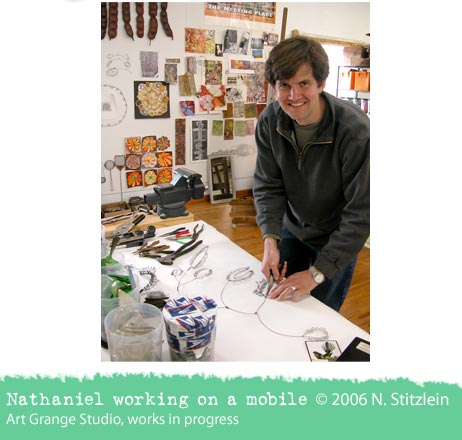
Nathaniel
and hIs wife, Michelle Stitzlein work as a team. Nathaniel
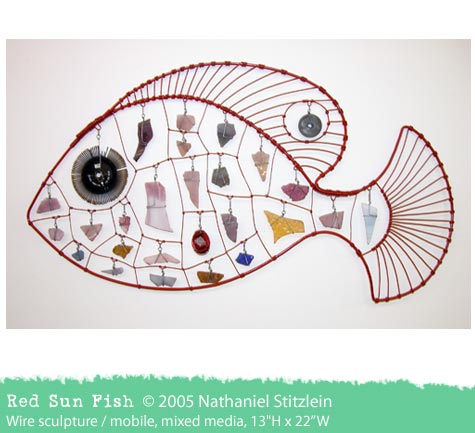
Stitzlein creates wire sculptures based on various types of
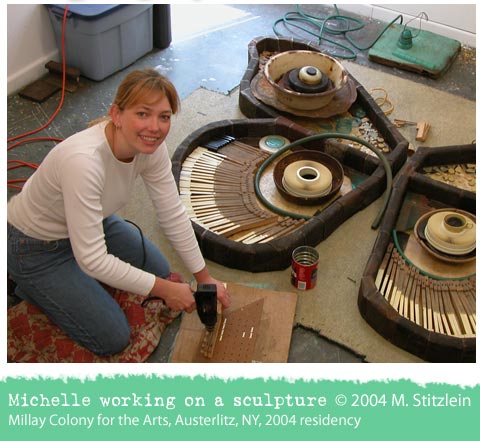
fish, birds, plants, people and animals. Michellecreates
found object art / sculpture from recycled materials, including piano keys,
broken china, license plates, rusty tin cans, electrical wire, bottlecaps,
and other miscellaneous items.
Nathaniel's 3-dimensional
creations can be hung from the ceiling, casting beautiful shadows on the
surrounding walls and floor. The mixed media pieces with glass shards create
dancing rays of color when hung near a window or another light source.
Some sculptures are flat and meant to be hung directly on the wall. He
has recently begun creating wire mobiles inspired by the wide diversity
of seed pods. Special orders/commissions are accepted. He can create
wire portraits based on photos of your favorite people and/or pets! Michelle
has a very busy schedule of exhibitions, lectures and workshops.
Michelle is a graduate of
the Columbus College of Art and Design and Nathaniel earned his BFA from
the Ohio State University. They each have over 15 years of experience designing
logos, postcards, brochures, websites, packaging, magazine layout/advertising,
signage, posters and the occasional t-shirt. The Mac-based studio utilizes
a wide range of Adobe design software. They have also illustrated advertisements
with oil pastels, wood cut prints, pen & ink sketches, digital photographs
and architectural/interior renderings. Both Michelle and Nathaniel are
naturally attracted to bold, colorful, design statements in art, design
and architecture. They rarely disagree over design topics but there is
an occasional spat about whose turn it is to order the printer toner.
In December of 2000,
Nathaniel and Michelle purchased the Grange in Baltimore, Ohio, that while
somewhat simple (maybe even homely) architecturally, offered everything
from the viewpoint of an artist. Light, space... and more space. Michelle
and Nathaniel renovated the lower level for their living quarters and maintained
the open space on the upper level for their studios. Art Grange Graphics
is located in Baltimore, Ohio (25 minutes outside of Columbus) in the former
Grange Hall. Their studio offers flexible, timely service at a competitive
rate and welcomes other artists in the area.
Ruth
Asawa - http://ruthasawa.com/tiedwire.html
- tied wire and freely branching forms modeled on nature
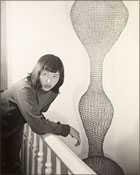
Born Ruth Aiko Asawa on January
24 1926 in Norwalk, a farming community in Southern California, to Umakichi
and Haru Asawa. She is the fourth of seven children. Her parents are immigrants
from Japan who make their living as truck farmers growing seasonal crops
— strawberries, carrots, green onions, tomatoes. Due to discriminatory
laws against the Japanese, her parents are not allowed to become American
citizens nor own land in California.
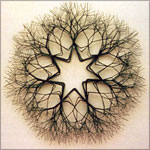
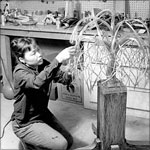
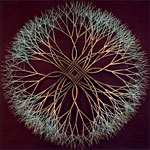
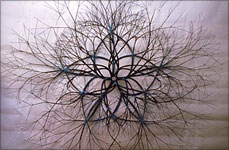
In 1962, Asawa started making
tied-wire sculptures like the ones shown here. "I started in 1962 when
a friend of ours brought a desert plant from Death Valley and said, 'Here's
something for you to draw.' I tried to draw it, but it was such a tangle
that I had to construct it in wire in order to draw it. And then I got
the idea that I could use it as a way to work in wire. I began to see all
the possibilities: opening up the center and then making it flat on the
wall, and putting it on a stand." Asawa often describes these tied-wired
sculptures using terms from nature, such as "tree" and "branching form."
She began with freely branching forms modeled on nature, and then refined
them into more abstract forms using geometric centers of four, five, six,
and seven points. If you look at these sculptures, you can see how the
number of points in the center defines the forms that the branches take.
Ruth graduated from high
school at a camp in Rohwer, Arkansas. Through a scholarship from the Quakers,
she studied to be an art teacher at Milwaukee State Teachers College in
Wisconsin. She earned her way as a domestic servant and by work in a tanning
factory. In 1945, she traveled to Mexico City with her sister Lois to study
Spanish and Mexican art. To get her credential, Asawa was required to practice-teach
in a school, but administrators at Milwaukee State Teachers College told
her that they can’t find her a teaching position because of lingering ill-will
against the Japanese. Since she couldn't complete her degree, she went
to Black Mountain College where she studied with one of the most important
teachers in American Art. His name was Josef Albers and he was from a famous
art school in Germany called the Bauhaus. The most important lesson she
learned from Albers was to experiment with materials. "The artist must
discover the uniqueness and integrity of the material." Albers called these
exercises matiere exercises. In the 1950s, Asawa focused on experimenting
with crocheted wire sculptures at home while looking after her six young
children.
Asawa exhibits her work —
sculptures, paintings, and drawings — in solo and group shows at the San
Francisco Museum of Art, the Oakland Art Museum, the Whitney Museum of
American Art, the Museum of Modern Art in New York, and the M.H. de Young
Memorial Museum in San Francisco. In 1962, she begins experimenting with
tied-wire and electroplating techniques. In 1965, she receives a Tamarind
Lithography Workshop Fellowship that allows her to spend two months in
Los Angeles making prints with master printmakers. She has major solo retrospective
exhibits at the San Francisco Museum of Art (1973), the Fresno Art Center
(1978 and 2001), the Oakland Museum (2002), the M.H. de Young Memorial
Museum (2006), the Japanese American National Museum (Los Angeles, 2007)
and the Japan Society (New York, 2007).
Additional sculptors of interest:
Dina
Torrans - http://dinatorrans.com/sculpture.html
- (CTS technician and instructor) mixed media sculpture
Sal Villano - http://salvillano.com
- Beaded and Wire Tree Sculptures
Pedro Girardello - http://pedrogirardello.blogspot.com
- large steel bar sculptures - human and horse
Donald Kolberg - http://donaldkolberg.com
- human form in its figurative and abstract appearance in wire mesh
Elizabeth Berrien - http://wirelady.com/photos.html
- World Class Wire Sculpture and illustration
Angela Hook - http://wireinspire.com/gallery.html
- Specializing in equine sculpture using copper wire
Lisa Fedon - http://lisafedon.com/WebPages/Portfolio.html
- functional, figurative items for the garden in steel and wire
Sten Hoiland - http://stenwire.com
- Whimsical 3D People and Animals made from wire
Jane and Bob Christie
- http://twistedsistercreations.com/wire-sculpture/index.htm
- cold-formed techniques of twisting and crimping wire
John Clair Watts - http://johnclairwatts.com
- abstract assemblages with wire and metal pieces
Ilse Bolle - http://ilsebolle.womanmade.net/gallery
- nature/fibre/found objects used in abstract constructions
Lisa Ross Miller - http://lisarossmiller.womanmade.net/gallery.html
mixed media to explore interplay between environment, biology, and ecology
Claudia Arashiro - http://claudiaarashiro.com
- ornamental metal work reflecting nature
Brent Bukowski - http://brentbukowski.ca/gallery.htm
- metal and wire and glass constructions that examine the expansion of
world consumption
J. Joy DenHartough -
http://positivelystoned.com
- Karma correction copper wire sculptures
Wire Magic - mages of
original wirework by makers from around the world gives links for wire
sculptors - http://www.wire-magic.co.uk/gallery.html
Going Beyond Ceramics: A High Wire
Act
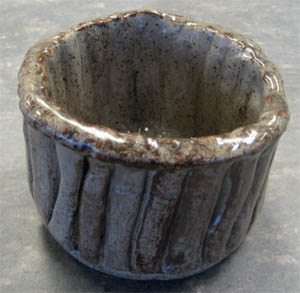
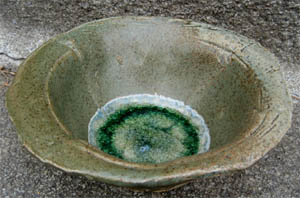
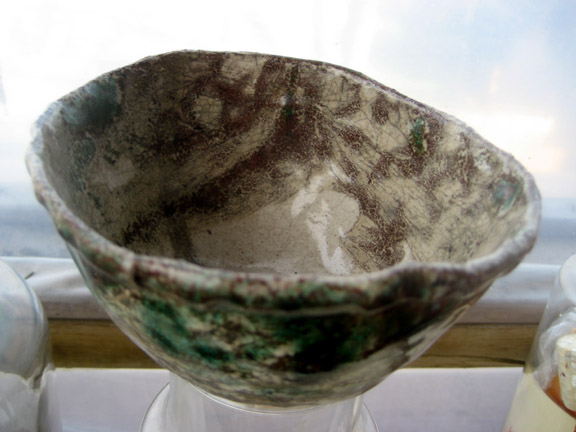
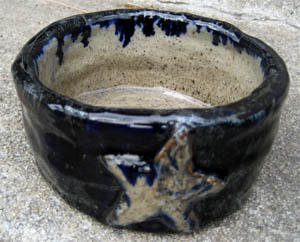
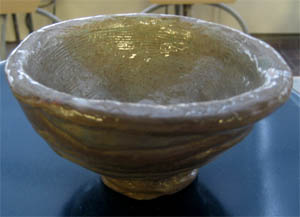
:I have five ceramic
bowls and each serves as the inspiration and base or starting point for
a series of mixed-media sculptures. These bowls of various shapes are of
glazed and twice-fired clay. Each sculptural piece is shaped incorporating
a bowl, wire, wire mesh and a variety of ornamental beads. This engaging
body of work involves an exploration in which materials combine to achieve
unique abstract forms that express feelings and reflections on the creative
process in my artistic journey.
Selia Karsten drkarsten@astralsite.com